
“After much consideration, we have made the difficult decision to discontinue ongoing support for KICK.”
Yikes. You can read the full announcement here:
Considering @ToppsDigital was selling packs and gems in it’s Topps Kick iOS/Android application as recently as 24 hours prior to the announcement, portraying this as a “difficult decision” along with the additional “We’d like to celebrate the community…” language comes off strikingly cold and disingenuous.
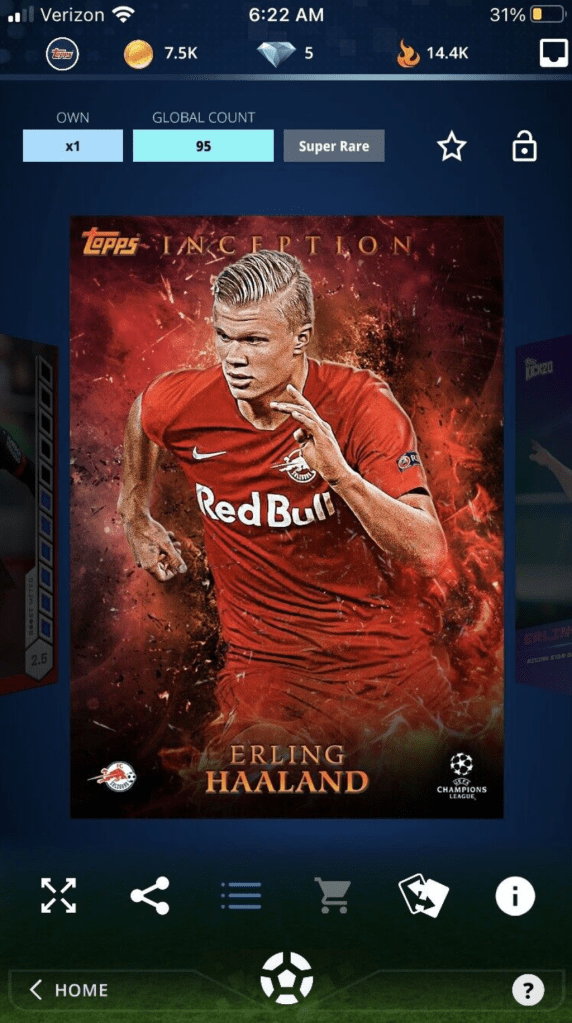

Initially announced on July 12th as a complete rug pull, Topps since updated it’s stance and will archive customers’ collections as it’s done with other digital app collections over the years. This means your digital cards remain available to view, but cannot be bought/sold/traded (outside of a complete account sale). You’re essentially donating your stuff to a museum without any of the tax benefits. Congratulations!
If this is your first experience like this, it’s understandably frustrating and probably leaves you with some questions like, “WTF did I buy?” and “Is this even legal?”. Logical questions in trying times.
A little digging reveals when these digital collecting applications hit the market, beginning with Topps Bunt, back in 2012. At the time (and still today) the digital cards were legally defined as components of the “Apps (including all software, content, virtual items and other material associated with the Apps)” in the Mobile Terms of Service, which provides them the right to terminate “in our sole discretion at any time, and for any reason or no reason, and without notice or liability…”
In blunt terms, the digital cards you buy on Kick, Bunt, Blitz, Dunk, are not viewed as standalone assets in a legal sense. In fact, they are quite clearly defined as a component of a complete service offering that can be modified at any time without liability. Basically, you don’t own them and “it’s in the fine print”.
To recap:
- “WTF did I buy?” – You bought temporary access to licensed digital content hosted by Topps
- “Is this even legal?” – Unfortunately, yes. Explicitly.
Soooooo where does that leave us in the world of digital trading cards?
Who better to ask than everyone’s favorite Twitter hobby lawyer, @Paul Lesko:
“I think Digital cards–as compared to NFTs–are controlled by fairly unfriendly (to the collector) and dense terms of service. Unfortunately then, to speak intelligently on these products you’d need to read the terms of service…and I can’t think of a form of torture worse than that. However, as these digital products “lives” are determined by the ToS, it’s important if you “buy” into one that you familiarize yourself with the terms so you can see what could happen to your collection in the future. And as the industry has shown, there is a very real risk of the products no longer being supported by the manufacturers…leaving your cards less collectable and valuable.“
Yes, your Topps Kick stuff has entered digital purgatory and there is no logical or legal path to salvation. None.
Quite the uplifting blog today huh?
Now let’s see what our favorite hobby lawyer has to say about NFT’s (yep, there it is, you knew it was coming!):
“As compared to digital trading card assets, NFTs are more ‘real world’, shockingly. There, where consumers feel they have been slighted, they’ve actually taken to the courts. Emphasizing the difference between digital trading cards and NFTs, courts have seemingly adopted this strategy. For example, in the Dapper Labs case as to whether its Top Shot Moments are unlawful securities, the court denied Dapper Labs’ motion to dismiss…meaning the court would delve into the merits of the case and allow discovery.“
That’s not to say anyone is predicting the outcome of the case, but it does tell us the court is exploring this technology with open eyes and ears, and has already established a potential difference between NFT’s and digital trading cards by not dismissing the case outright. What are those differences legally? We’re all waiting to find out.
The Case for True Digital Ownership via NFT
So what does it mean to “own” something in the digital realm and what does that mean for the value of your digital items long term?
As Paul points out above, it starts with the terms and conditions you agree to when you make a purchase, so let’s start by taking a look at some distinctly different terms from lets say…..ToppsNFTs.
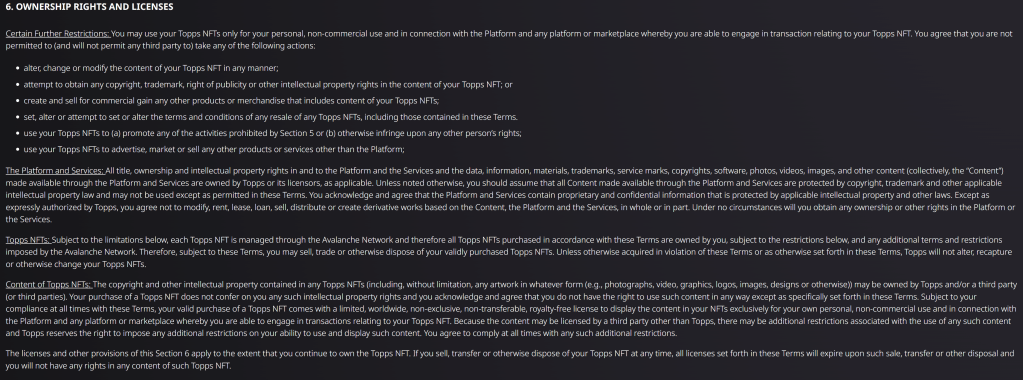
TLDR:
The “Platform and Services” comprises all of Topps owned or licensed “Content” which is protected by copyright, trademark and other IP law.
“ToppsNFTs” (a defined term) are “managed through the Avalanche Network (another defined term) and therefore all Topps NFTs purchased in accordance with these Terms are owned by you… Unless otherwise acquired in violation of these Terms or as otherwise set forth in these Terms, Topps will not alter, recapture or otherwise change your Topps NFTs.”
Wow. That’s extremely different language than Bunt/Kick terms where, if we recall from earlier in this article, the digital cards are legally defined as components of the “Apps (including all software, content, virtual items and other material associated with the Apps)” which provides them the right to terminate “in our sole discretion at any time, and for any reason or no reason, and without notice or liability…”
Ok, so that’s a positive right? What about the Avalanche Network? What additional terms and restrictions do they impose? The short story is none, really. While Avalanche maintains the right to remove or terminate users from their network (an absolute must security measure for a corporate + public blockchain), the incentives are correctly aligned for them to continue supporting and growing both the NFT and larger blockchain ecosystems globally. A quick google search can show this is already in motion.
Wen Moon
So what does that mean for the value of NFTs long term? Well, for the first time ever, we’ve established legal provenance of a digital item as its own legally defined entity. Second, it means you’re very unlikely to get rugged in a similar fashion to Topps Kick, and that if you do, you may have legal recourse. Lastly, it means we’ve finally aligned a correct incentive structure where Topps (or any other NFT “manufacturer”) makes passive income on digital trading cards forever and Avalanche keeps operating the infrastructure and innovating within their network and product suite.
Fifa+ Collect, a project I’ve mentioned in articles but haven’t blogged about directly yet, have setup their terms of service in a similarly structured combination with Algorand blockchain. This project also recently announced a self-custody feature, the first licensed soccer project to do this since Sorare.
Don’t get me wrong, the NFT market is in flames right now (not the good kind), and while this is all taking much longer than expected or most would have wanted, I can see the pieces slowly falling into place. The path to true, legal, digital ownership is in motion.
If you’d like to learn more about licensed soccer NFT’s and why they have the potential to unify one of the largest fragmented markets in the world (soccer collectibles), or if you just want to talk about Messi’s latest golazo for Miami, come give us a shout. – EPL out
 EPLToken.world Soccer NFTs